
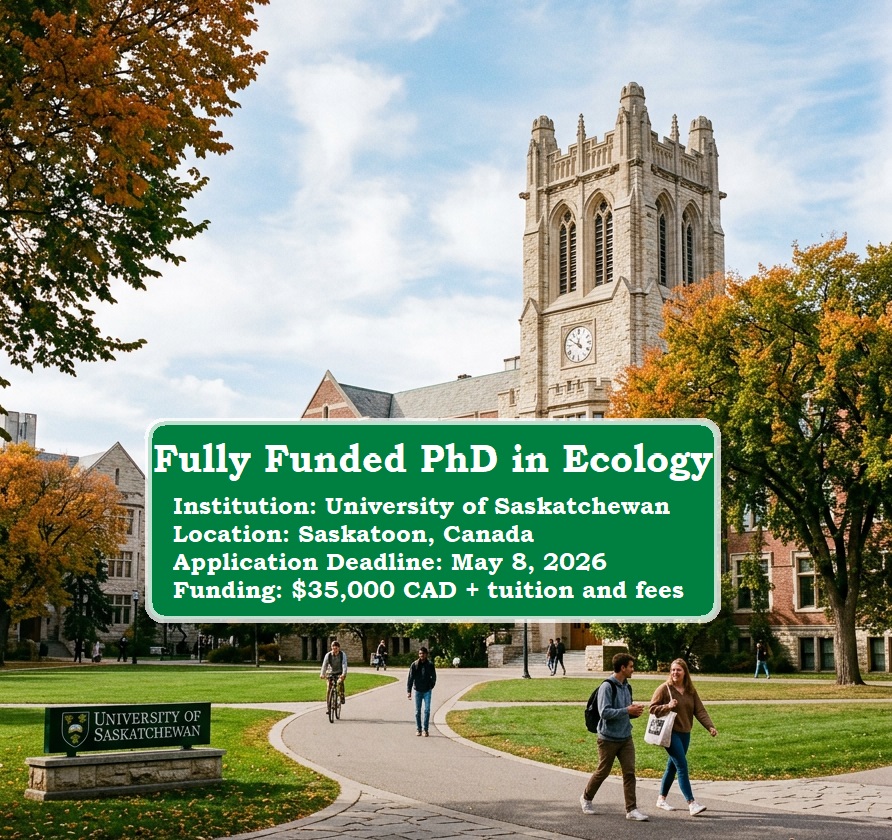
A fully funded PhD opportunity is now available at the University of Saskatchewan for students interested in avian ecology, disease dynamics, and spatial data analysis. This position focuses on understanding how waterfowl interact with agricultural landscapes and how these interactions influence the spread of highly pathogenic avian influenza (HPAI).
The project is led by Mitch Weegman in collaboration with Jolene Giacinti and John Coluccy, offering a highly interdisciplinary research environment. This PhD position offers a focused and impactful research pathway at the intersection of ecology, data science, and disease management—an increasingly important field in a changing global environment.
Position Overview
- Institution: University of Saskatchewan
- Location: Saskatoon, Canada
- Application Deadline: May 8, 2026
- Start Date: September 2026 or January 2027
- Workload: 37–38 hours per week
- Funding: $35,000 CAD per year + tuition and fees
- Degree: PhD
Research Focus: Waterfowl Movement and HPAI Transmission
Highly pathogenic avian influenza continues to pose serious challenges to wildlife conservation, agriculture, and public health. This project aims to better understand how wild waterfowl interact with farm environments and how these interactions contribute to disease transmission risk.
Rather than collecting new field data, the research will primarily involve advanced analysis of existing datasets, including GPS tracking data of waterfowl movements.
Key Research Objectives
The selected PhD student will lead data-driven investigations into:
- Fine-scale habitat use of GPS-tagged waterfowl near poultry and dairy farms
- Spatial overlap between bird movements and agricultural operations
- Differences between farms with and without prior HPAI outbreaks
- Implications for biosecurity, wildlife conservation, and One Health frameworks
This work will directly inform strategies to reduce disease transmission at the wildlife–agriculture interface.
Why This Project Matters
The intersection between wildlife ecology and agricultural systems is a growing area of global concern. This research contributes to:
- Improved biosecurity practices in farming
- Better understanding of zoonotic disease pathways
- Conservation of migratory bird populations
- Evidence-based policy development
The project aligns with the broader One Health approach, integrating environmental, animal, and human health perspectives.
Research Approach and Skills Development
This is a quantitatively intensive PhD project, ideal for candidates interested in computational ecology and spatial modeling.
Core Methods
- Analysis of large-scale GPS tracking datasets
- Spatial and movement ecology modeling
- Statistical analysis using R
- Integration of environmental and agricultural data
Additional Opportunities
- Participation in related fieldwork across North America
- Collaboration with government and non-government partners
- Development of independent research questions and publications
Ideal Candidate Profile
Applicants should have:
- MSc in ecology, statistics, or a related discipline
- Strong quantitative and analytical skills
- Experience with R programming and large datasets
- Interest in avian ecology or movement ecology
Preferred but Not Required
- Background in disease ecology
- Experience with spatial modeling or GIS
Expectations and Outcomes
The successful candidate will:
- Publish research in peer-reviewed journals
- Present findings at scientific conferences
- Communicate results to stakeholders, including policymakers and conservation organizations
- Adhere to strict data confidentiality and governance protocols
Application Process
To apply, submit the following documents (preferably as a single PDF) to both supervisors:
Required Materials
- Letter of interest (cover letter)
- Curriculum Vitae (CV) or résumé
- Unofficial academic transcripts
- Contact information for three references
- Contact Emails: mitch.weegman@usask.ca & jolene.giacinti@ec.gc.ca
- Applications must be submitted by May 8, 2026.
Contact Information
- Lead Supervisor: Mitch Weegman
- Email: mitch.weegman@usask.ca
Frequently Asked Questions (FAQs)
Is this PhD position fully funded?
Yes. The position offers $35,000 CAD annually, along with full tuition and fee coverage.
Will I need to conduct fieldwork?
The core project is analysis-based using existing datasets. However, there may be optional opportunities for fieldwork on related projects.
What is HPAI and why is it important?
Highly pathogenic avian influenza is a viral disease affecting birds, with implications for agriculture, wildlife conservation, and public health.
Do I need strong programming skills?
Yes. Proficiency in R and experience with data analysis are important for success in this project.
Can international students apply?
Yes. Canadian universities typically accept international applicants, though visa and admission requirements must be met.
What kind of datasets will I work with?
You will work with GPS tracking data of waterfowl, agricultural land-use data, and disease occurrence records.
Is prior experience in disease ecology required?
No, but it is considered an advantage. Strong analytical skills are more critical.
What career paths can this PhD lead to?
Graduates may pursue careers in academia, government agencies, conservation organizations, or data science roles in environmental and public health sectors.
Discover more from Agristok
Subscribe to get the latest posts sent to your email.