
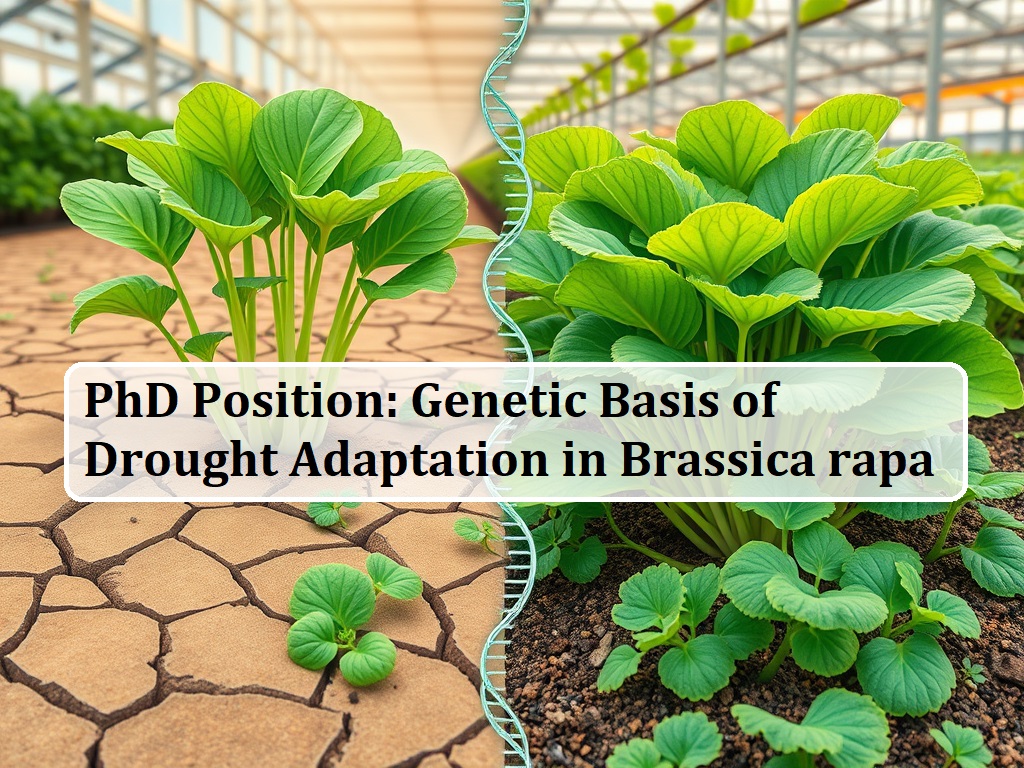
The Heinrich Heine University Düsseldorf (HHU) is offering an exciting three-year PhD position (65%, EG 13 TV-L) at the Institute for Plant Ecology and Evolution. This DFG-funded project investigates one of the most urgent biological questions of our time: how natural plant populations genetically adapt to rapid climate change.
If you are passionate about evolutionary ecology, plant genomics, and quantitative genetics, this opportunity places you at the forefront of climate adaptation research in Europe. Application deadline: March 2, 2026
Expected start date: As early as possible
Research Focus: Rapid Adaptation to Drought in Brassica rapa
Climate change is increasing the frequency and intensity of drought events worldwide. Understanding how plants evolve in response to these pressures is critical for biodiversity conservation, agriculture, and ecosystem resilience.
This PhD project focuses on two Californian populations of Brassica rapa that show parallel phenotypic shifts under drought conditions but differ genetically. This rare natural experiment allows researchers to disentangle:
- Environmental effects
- Genetic architecture of adaptive traits
- Trait covariation under stress
- Evolutionary constraints and trade-offs
The project integrates ecological experiments, resurrection approaches, and advanced genomic analyses.
What Makes This Project Scientifically Unique?
The study combines classic evolutionary ecology with cutting-edge genomic tools:
- Resurrection-based common garden experiments
- SNP-based population genomics
- Genome-wide association studies (GWAS)
- Quantitative trait locus (QTL) mapping
- Quantitative genetic modeling
This integrative framework allows the PhD candidate to link phenotypic evolution directly to underlying genetic variation.
Core Methodological Framework
1. Common Garden Experiments
Resurrection-based common gardens will be established at HHU to grow ancestral and descendant generations under controlled drought and non-drought conditions. This design enables direct measurement of evolutionary change across generations.
You will quantify:
- Trait means and variances
- Genetic correlations
- Environmental covariance structures
- Drought-responsive phenotypic plasticity
2. Quantitative Genetics and Trait Architecture
Understanding how traits evolve requires analyzing variance components. One central concept in quantitative genetics is phenotypic variance:VP=VG+VE
This framework partitions total phenotypic variance (VP) into genetic variance (VG) and environmental variance (VE), forming the basis for estimating heritability and evolutionary potential.
Through this lens, you will assess how drought influences:
- Heritability of key traits
- Genetic correlations among traits
- Evolutionary constraints
3. Genome-Wide Association Studies (GWAS)
GWAS will be used to identify SNP markers associated with drought-adaptive traits. The project leverages high-resolution genomic data to uncover:
- Polygenic adaptation patterns
- Effect sizes of loci
- Shared versus distinct genetic pathways in parallel evolution
4. QTL Mapping
Complementary to GWAS, QTL mapping enables detection of genomic regions contributing to quantitative traits under drought stress. This approach provides insights into:
- Genetic architecture complexity
- Pleiotropy and linkage
- Trait co-evolution
Together, GWAS and QTL mapping offer a powerful toolkit for dissecting adaptation at multiple genomic scales.
Your Responsibilities as a PhD Candidate
- Establish and manage resurrection-based common garden experiments
- Process phenotypic, environmental, and genomic datasets
- Perform GWAS, QTL mapping, and quantitative genetic analyses
- Present research at international conferences
- Publish findings in peer-reviewed journals
- Contribute to teaching and supervise students
This position combines experimental plant ecology with computational genomics—ideal for candidates seeking broad, high-impact research training.
Candidate Profile
Required Qualifications
- MSc in Biology, Ecology, Evolutionary Biology, or Quantitative Genetics
- Strong background in evolutionary ecology and genetics
- Experience with NGS data or population genomics
- Excellent English communication skills
- Strong organizational and teamwork abilities
Preferred Qualifications
- Experience with plant common garden or greenhouse experiments
- Programming skills in R, Python, or bash
- Familiarity with GWAS and QTL workflows
- Scientific writing experience
- German language skills
- Legal eligibility to work in the EU
Research Environment and Career Development
This DFG-funded position is embedded in a dynamic research environment with potential association to:
- TRR 341
- CEPLAS
Doctoral training is supported through structured programs such as:
- iGRAD
- JUNO
- HeRA
The institute offers an international, family-friendly working environment and strong interdisciplinary collaboration in plant ecology, evolution, and genomics.
Why This PhD Is Highly Competitive
- Climate change adaptation research is a high-priority funding area globally
- Genomic expertise in drought adaptation has strong academic and applied relevance
- Skills gained are transferable to agriculture, conservation, and biotechnology
- Germany offers structured doctoral training and competitive salary (EG 13 TV-L, 65%)
For students aiming at careers in academia, plant breeding, or evolutionary genomics, this position provides rigorous methodological training and strong publication potential.
Application Instructions
Submit a single PDF including:
- Cover letter (max. 2 pages) describing motivation and research fit
- CV with publication list and two references
- BSc and MSc certificates and transcripts
- Send applications to: elena.hamann@hhu.de & Subject line: Application PhD Genetics
- Deadline: March 2, 2026
Frequently Asked Questions (FAQ)
Is this PhD fully funded?
Yes, the position is funded by the German Research Foundation (DFG) and follows the EG 13 TV-L salary scale at 65% employment.
What is a resurrection experiment?
A resurrection experiment grows ancestral and descendant populations side by side to directly measure evolutionary changes across generations.
Do I need programming experience?
Programming in R, Python, or bash is highly advantageous, especially for genomic and quantitative genetic analyses.
Is knowledge of German mandatory?
Excellent English is required. German skills are preferred but not strictly mandatory.
Can international applicants apply?
Yes, provided they meet the academic requirements and have legal authorization to work in the EU.
What career paths does this PhD prepare me for?
Graduates typically pursue careers in:
- Academic research
- Evolutionary genomics
- Climate change biology
- Plant breeding and crop improvement
- Conservation genetics
Discover more from Agristok
Subscribe to get the latest posts sent to your email.